




Enterprise AI has entered a different phase in 2026. For large organizations, the question is rarely whether a language model can summarize documents, generate code, retrieve knowledge, or automate part of a workflow. Engineering teams have already demonstrated those capabilities repeatedly.
The harder question is whether the system can operate reliably when thousands of employees, customers, transactions, APIs, security policies, and business rules become involved.
That distinction matters because adoption is increasing faster than measurable enterprise value. McKinsey’s 2026 State of AI research found that 44% of organizations now report scaling AI across the enterprise, up from 38% a year earlier. Among organizations with at least $1 billion in annual revenue, the figure reaches 54%. Yet only 37% of respondents said AI had contributed to EBIT, essentially unchanged from the previous year.
For VPs of Engineering and digital platform leaders, that gap has become the real implementation problem.
Why do enterprise AI pilots work but fail in production?
A pilot answers a narrow question: can AI perform the task?
Production asks several harder questions simultaneously.
Can it perform the task consistently? Can engineers trace why it produced an answer? What happens when a dependency fails? Can security teams control which data the model sees? Can the business measure whether the AI is improving the workflow rather than merely increasing activity?
Stanford Digital Economy Lab examined 51 enterprise AI deployments that had already achieved measurable value. Its researchers found that 77% of the hardest implementation challenges involved less visible factors such as change management, data quality, and process redesign. The research also found that similar AI use cases could take weeks in one organization and years in another because organizational readiness differed substantially.
This explains why adding a stronger model rarely rescues a stalled implementation.
A customer-service prototype, for example, may demonstrate strong answers against a curated set of documents. Production requires identity management, permissions, retrieval pipelines, evaluation datasets, escalation logic, audit logging, latency controls, cost monitoring, fallback mechanisms, and integration with CRM or ticketing systems.
The AI model is only one component.
Enterprise teams therefore need to stop treating production as the final stage of a proof of concept. Production requirements have to influence architecture from the beginning.
What architecture does production enterprise AI actually require?
Traditional software engineering assumes deterministic application logic. AI introduces probabilistic behavior into systems that may already span dozens of services.
That changes the architecture.
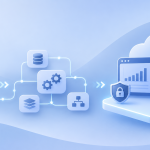
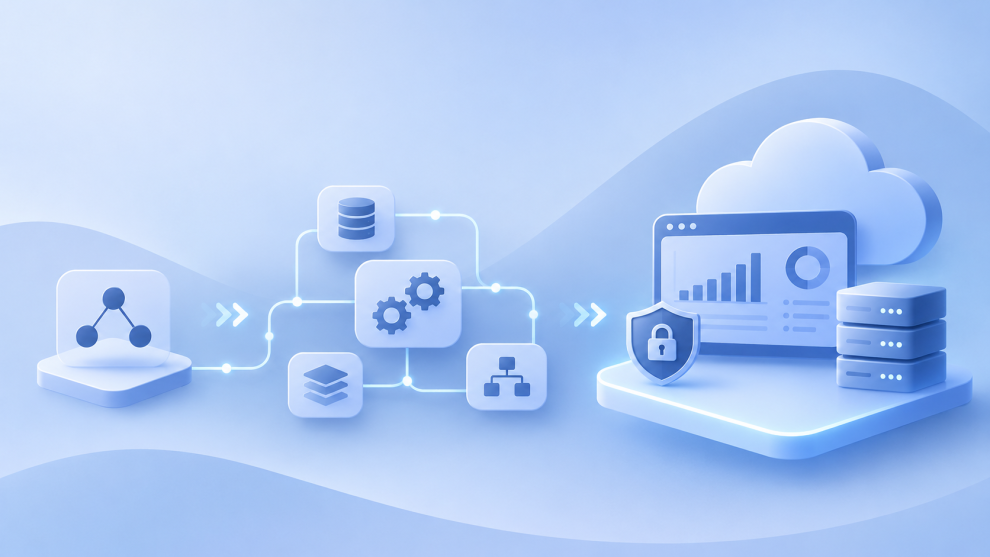
A production AI application usually needs an orchestration layer separating the business workflow from individual models. The architecture should allow teams to replace models without rewriting the entire application. It also needs a governed data layer for retrieval, grounding, access control, and data lineage.
Model output then requires an evaluation layer.
Teams should measure factual correctness, task completion, safety, latency, cost, retrieval quality, and failure patterns against predefined datasets. For agentic systems, evaluation must also cover tool selection, API execution, intermediate reasoning states, permissions, and whether the agent knows when to stop or escalate.
Observability becomes equally important.
Engineering teams need traces showing the prompt, model, retrieved context, tool calls, token consumption, latency, output, and user response for important transactions. Without this information, production debugging becomes guesswork.
This requirement becomes more important as agents gain authority. McKinsey found that 40% of respondents from large organizations reported scaling AI agents in at least one function in 2026, compared with 27% the previous year.
The engineering question is therefore shifting from “Can the model answer?” to “What authority should the system receive, and how will that authority be controlled?”
What should an enterprise AI implementation playbook include in 2026?
A practical production program should treat AI implementation as an engineering and operating-model change rather than a model deployment exercise.
- Start with a workflow that has measurable economics. Teams should define the business event, current processing time, labor involved, error rate, transaction volume, downstream impact, and cost of failure before selecting technology. “Improve employee productivity” is difficult to validate. “Reduce manual review time for 60,000 monthly claims while maintaining the existing escalation threshold” gives engineering, finance, and operations a measurable target.
- Design the data boundary before building the experience. Teams need to identify the systems of record, sensitive fields, retention requirements, user permissions, retrieval sources, and jurisdictions governing the data. Retrieval quality should be tested independently from generation quality because many apparent model failures originate in missing or poorly retrieved enterprise context.
- Separate orchestration from model providers. Models will continue changing rapidly. Business rules, workflow state, tools, prompts, retrieval, guardrails, and evaluation logic should therefore sit outside the model whenever practical. This reduces model lock-in and gives teams room to route different tasks to different models based on accuracy, latency, security, and cost.
- Build evaluation before scale. Production teams need representative test sets containing normal transactions, edge cases, ambiguous inputs, adversarial scenarios, and known failure conditions. Each meaningful release should be tested against the same baseline. An impressive demo should never substitute for repeatable evaluation.
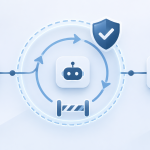
- Define human intervention around risk. Human review should not automatically be inserted into every AI action. It should reflect business consequences. Low-risk classification may execute automatically, while financial decisions, regulated actions, unusual transactions, or low-confidence outputs can require escalation. Stanford’s 2026 research found that escalation-based implementations in its sample were associated with substantially higher median productivity gains than workflows requiring approval for every action, although the researchers caution that task differences may partly explain the result.
- Operate AI like a production service. Teams should monitor latency, token consumption, inference cost, retrieval failures, hallucination patterns, tool errors, model changes, user overrides, and business outcomes. Incident response must include the ability to disable a model, tool, workflow, or agent capability without taking the broader application offline.
- Scale only after the unit economics survive real traffic. AI systems can look economical at pilot volume and become expensive at enterprise scale. Leaders should calculate cost per completed business outcome rather than cost per model request. That includes inference, retrieval infrastructure, observability, engineering support, human review, security, and ongoing evaluation.
This operating discipline is especially important because AI operating costs are already becoming material. McKinsey reported in 2026 that AI-related operating costs were constraining AI use for roughly one in five organizations.
How can leaders tell whether an AI system is actually ready to scale?
A production-ready system should survive a different evaluation from a pilot.
Engineering leadership should be able to explain what happens when the primary model becomes unavailable, when retrieval returns conflicting information, when an agent attempts an unauthorized action, when cost per transaction doubles, and when performance deteriorates after a model update.
The business owner should also be able to identify the metric the system is expected to change.
If nobody can connect the AI system to cycle time, revenue, operating cost, quality, risk, customer conversion, service capacity, or another measurable business result, scaling it will probably increase AI usage without establishing AI value.
Deloitte’s 2026 enterprise AI research illustrates the challenge. Only 25% of surveyed organizations said they had moved at least 40% of their AI pilots into production. Only 30% reported redesigning key processes around AI.
That suggests production maturity depends as much on workflow redesign as technology deployment.
When should enterprises bring in an AI implementation partner?
External support becomes useful when the bottleneck is no longer model experimentation but production engineering capacity.
Large organizations often already have cloud teams, security functions, data platforms, architecture standards, and strong domain experts. What they may lack is a team that can connect those capabilities into a production AI system quickly enough to establish a repeatable implementation pattern.
The market includes different models. Accenture combines AI transformation with large-scale enterprise consulting and systems integration. Deloitte brings strong transformation, risk, governance, and industry consulting capabilities. GeekyAnts represents a more product-engineering-oriented option for organizations that need to move AI prototypes into production applications, integrate them with existing platforms, or assemble focused AI engineering teams.
The appropriate choice depends less on brand size than on the implementation gap.
Enterprises should examine whether a partner can work across application engineering, AI orchestration, cloud infrastructure, data integration, security, evaluation, observability, and post-launch operations. A team that can build an impressive prototype but cannot own those production concerns simply moves the bottleneck forward.
What should enterprise AI leaders do next?
The strongest 2026 AI programs are unlikely to be the organizations running the largest number of pilots.
They will be the ones that establish a repeatable mechanism for turning a small number of valuable use cases into governed, observable, economically sustainable production systems.
That requires architecture, workflow redesign, evaluation, governance, change management, and operational ownership to develop together.
For engineering leaders with several AI pilots competing for investment, the next useful exercise may therefore be narrower than another enterprise AI strategy workshop.
Choose one candidate expected to reach production. Map its workflow, data dependencies, architecture, risk boundaries, evaluation requirements, operating costs, and measurable business outcome.
A focused production-readiness discussion around that single use case can often reveal more about an organization’s real AI maturity than another quarter of experimentation.






Add Comment