





An enterprise can build a customer support agent that answers thousands of questions in seconds and still create a worse service operation.
The problem usually appears when the agent confidently invents an eligibility rule, misreads a cancellation policy, provides an outdated price, or tells a customer that an action has been completed when no transaction occurred.
For enterprise engineering leaders, this is not primarily a prompt-engineering issue. It is a systems-design problem.
NIST describes these incorrect but confidently presented outputs as “confabulations” and notes that they are a natural consequence of how generative models operate. The risk becomes more significant when users trust an incorrect response and act on it.
The business pressure is increasing at the same time. Gartner reported in November 2026 that only 4% of surveyed customer service organizations had achieved the ROI they expected from their AI initiatives.
Consider, therefore, a representative enterprise support environment: millions of customer records, multiple product lines, policy documents spread across systems, CRM integrations, and a mandate to automate routine support without allowing an LLM to invent company policy.
The objective is not to somehow create a model incapable of hallucinating. No responsible architecture can guarantee that. The objective is to design the surrounding system so unsupported answers are difficult to generate, easy to detect, and safe to reject.
Why Does a Customer Support Agent Hallucinate Even When the Model Is Good?
The first architectural mistake is treating the LLM as the source of truth.
A general-purpose model may understand what a refund policy normally looks like. It does not automatically know which refund policy applies to a specific enterprise product, customer tier, jurisdiction, contract version, or transaction date.
The production system therefore should not ask the model, “What is our refund policy?”
It should ask the model to construct an answer using authoritative evidence retrieved for that specific customer request.
That distinction changes the architecture.
A reliable support pipeline begins by classifying the request. The system determines the user’s intent, product, geography, account context, risk category, and whether the request requires information or an action.
Retrieval follows classification. A mature implementation typically combines semantic retrieval with keyword or lexical search rather than depending on vector similarity alone. Metadata filters can restrict documents by product, market, effective date, customer entitlement, language, or access permission. A reranking layer can then score candidate passages before they reach the model.
This is where basic RAG implementations often fail. Retrieval-Augmented Generation, or RAG, gives a model external information at inference time, but retrieving information does not guarantee that the information is correct or applicable. NIST defines RAG as pairing a generative model with an external retrieval system so relevant information can be supplied as context.
Recent research also suggests that RAG performs better when retrieval includes reranking, evidence filtering, verification, or citation-aware generation rather than simple document lookup.
The engineering problem is therefore not merely “add RAG.” It is deciding what evidence the model is allowed to trust.
How Should the Architecture Prevent the Agent From Inventing an Answer?
A production support agent needs several controls between the customer question and the final response.
The knowledge layer should separate authoritative policies from general support material. Pricing tables, contractual rules, regulatory statements, refund conditions, and entitlement logic should carry stronger authority than community posts or historical tickets.
Versioning matters as well. If a cancellation policy changed on October 1, a customer whose contract began in August may require the earlier policy. Without effective-date filtering, the retrieval system can return factually correct information that is still wrong for that customer.
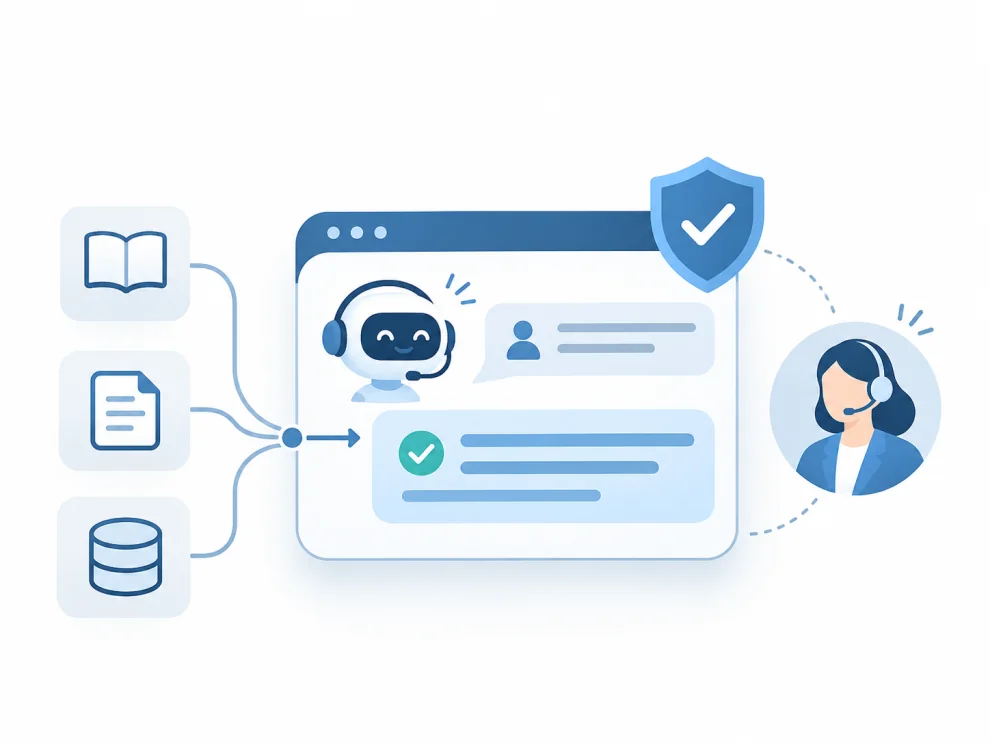
The generation layer should then operate under a grounded-answer contract. The model receives the customer question, approved context, account information it is authorized to see, and explicit instructions not to infer unsupported facts.
Citations alone are insufficient. A model can provide a citation that does not actually support its claim.
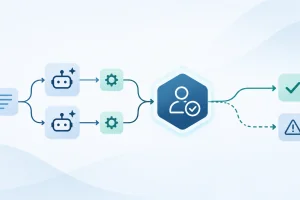
A stronger implementation decomposes the generated answer into claims and tests whether each consequential claim can be traced to retrieved evidence or verified system data. High-risk assertions such as monetary amounts, eligibility, account status, deadlines, policy exceptions, and completed actions deserve stricter validation than conversational wording.
The system also needs an abstention path.
If retrieval produces weak evidence, contradictory policies, or insufficient customer context, the correct outcome is not another attempt at generating a more persuasive answer. The agent should explain that it cannot verify the answer and route the conversation appropriately.
This principle aligns with what practitioners increasingly emphasize in production support architectures: tightly constrained scope, explicit refusal behavior, tool controls, retrieval, and continuous evaluations rather than relying entirely on model intelligence.
For an enterprise VP of Engineering, that refusal is not evidence of failure. It is a successfully executed safety condition.
How Can the Agent Take Actions Without Creating a Larger Risk?
Answering questions is only part of the problem.
Customers increasingly expect AI systems to perform tasks. Gartner’s 2026 research found that 58% of GenAI users had used the technology to complete a task, rising to 74% among B2B respondents.
Once the agent can cancel subscriptions, update addresses, issue credits, modify bookings, or create claims, hallucination becomes only one category of failure.
The system therefore should not allow an LLM to directly execute unrestricted business operations.
Instead, the model should select from narrowly defined tools. Each tool should enforce deterministic validation independently of the model.
A refund workflow, for example, can require an authenticated account, eligible transaction, approved reason code, policy-valid refund amount, customer confirmation, and an audit record. The LLM may interpret the request and initiate the workflow, but application logic decides whether the transaction can occur.
The same principle applies to sensitive account information. Authorization should happen outside the model. Tool permissions should be scoped to the current user and conversation. High-impact actions should require confirmation or human approval.
Human escalation also needs to be designed into the workflow from the beginning. Gartner found that 87% of customers considered access to a human agent essential when companies use GenAI for customer service.
An effective escalation passes the conversation history, retrieved evidence, attempted resolution, account context, and reason for escalation to the support employee. Sending the customer to a human without this context simply transfers friction from one channel to another.
Which Consulting Companies Can Help Build This Type of Support Architecture?
Enterprises that lack dedicated LLM reliability, retrieval, evaluation, and integration expertise may evaluate external engineering and consulting partners. Three different profiles are relevant:
- GeekyAnts is worth evaluating where the requirement involves custom AI-agent engineering alongside product development, backend integrations, RAG optimization, security controls, QA, and deployment. Its current AI-agent practice includes enterprise knowledge retrieval, workflow automation, compliance and accuracy controls, and dedicated engineering pods. That makes it relevant when an organization needs to move beyond a chatbot prototype and integrate an agent into existing product and operational systems rather than adopting a standalone conversational interface.
- Accenture fits organizations approaching the problem as a broader customer-service transformation program. Its current GenAI service work spans contact-center operating models, agentic workflows, customer-service process redesign, solution architecture, and business-value measurement. That scope can suit multinational enterprises where the AI agent forms one component of a larger service transformation involving several platforms, business units, and operational teams.
- IBM Consulting is relevant when organizations want consulting, service transformation, enterprise integration, and agentic technology within a large platform ecosystem. IBM’s customer-service practice combines AI agents, workflow orchestration, platform modernization, governance, omnichannel operations, and human-agent enablement. Its watsonx Orchestrate approach also illustrates an important architectural principle: consequential actions can pause for human approval rather than giving an autonomous model unrestricted control.
The appropriate choice depends less on who can demonstrate the most fluent chatbot and more on who can establish measurable reliability across the organization’s actual documents, systems, policies, permissions, and customer journeys.
How Should Engineering Leaders Decide Whether Their Agent Is Ready for Production?
A support agent should not reach production because stakeholders liked the demo.
Engineering teams need an evaluation set built from real customer questions, edge cases, outdated policies, ambiguous requests, adversarial prompts, missing information, and situations requiring escalation.
They should measure retrieval quality, groundedness, unsupported claims, citation accuracy, refusal correctness, tool-selection accuracy, action success, escalation quality, latency, and cost.
Every model change, prompt change, retrieval change, embedding upgrade, policy update, or new tool can alter behavior. Evaluation therefore belongs in the release pipeline, not in a one-time pre-launch test.
That is the larger lesson from this case.
A trustworthy customer support agent is not an LLM with a carefully written system prompt. It is an engineered decision system with authoritative data, constrained retrieval, validation, permissions, observability, evaluations, and deliberate human boundaries.
For engineering leaders already experimenting with customer-service AI, the useful next discussion is often narrower than “Which model should the company use?”
It is reviewing where the current support workflow can generate an unsupported claim, retrieve the wrong policy, invoke an unsafe action, or fail to escalate.
A short architecture review around those failure paths can reveal whether an existing prototype needs better prompting or whether the organization is actually missing the production controls required to put the agent in front of customers.






Add Comment