






An AI agent does not need to crash to create an expensive production incident.
It can remain perfectly healthy while calling the same search service repeatedly, retrying a failed API with slightly different parameters, asking another agent to reconsider an already resolved task, or continuing to reason because nobody gave it a measurable definition of “done.”
At enterprise scale, that behavior becomes more than an inference-cost problem. Repeated tool calls consume API quotas, hold infrastructure resources, create duplicate transactions, overwhelm downstream systems, and make customer-facing workflows unpredictable.
The issue is becoming more relevant as adoption moves beyond experiments. McKinsey’s 2026 State of AI survey found that 40 percent of respondents from organizations with more than $1 billion in annual revenue reported scaling AI agents, compared with 27 percent the previous year.
As agents gain access to production systems, engineering leaders therefore need to think differently about guardrails. A system prompt telling an agent to “avoid unnecessary calls” is useful guidance. It is not a production control.
Why do AI agents get trapped in expensive execution loops?
Most runaway agents are not behaving randomly. They are following poorly bounded instructions.
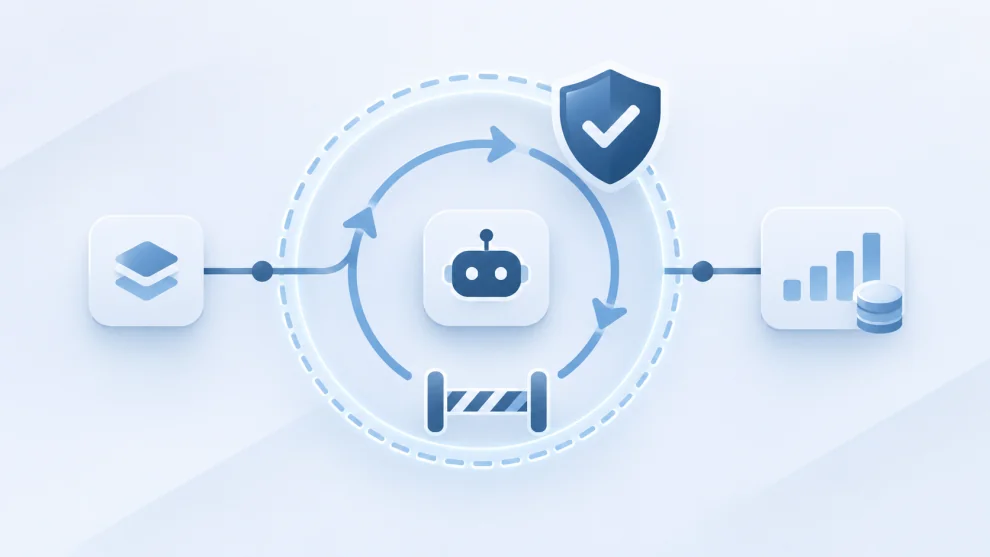
An agent normally operates through a repeated cycle: inspect the current state, decide what to do, invoke a tool, evaluate the result, and determine whether another action is required. If the system cannot objectively determine completion, the model can continue finding reasons to act.
Ambiguous tool definitions make the problem worse. Consider an enterprise agent with separate tools for searching customer records, retrieving account information, querying a knowledge base, and searching internal documents. If responsibilities overlap, the agent may move between them because each unsuccessful result appears to justify another retrieval attempt.
Retries create another failure mode. Traditional services typically have retry policies with maximum attempts and exponential backoff. Agentic systems can accidentally place retries at several layers. The HTTP client retries, the tool wrapper retries, and then the model decides that it should try again. One failed dependency can therefore generate substantially more requests than architects expected.
Multi-agent systems add another dimension. Agent A delegates to Agent B. Agent B decides more information is needed from Agent A. Unless the orchestrator tracks task ownership and completed work, delegation can become recursion.
OWASP now explicitly identifies “Denial of Wallet” as an agent security concern and recommends enforcing token, cost, retry, and tool-chain limits. Its agentic security guidance also warns against unlimited recursion and tool chaining.
That changes the engineering question. Teams should not ask whether an agent is likely to stop. They should ask what forces it to stop when its reasoning does not.
Which guardrails actually stop runaway agent execution?
Effective controls sit outside the model’s reasoning loop. The agent can recommend another action, but the runtime decides whether that action is permitted.
A production implementation usually needs several controls working together:
- Execution budgets should constrain multiple resources, not only tokens. Each run should have enforceable ceilings for model calls, tool invocations, retries, elapsed execution time, token consumption, external API spending, and potentially infrastructure-intensive operations. These budgets should exist at session, user, tenant, workflow, and service levels where appropriate. A 20-call session limit does little if hundreds of sessions can simultaneously hammer the same backend. The orchestrator should maintain a runtime ledger and reject the next operation before the limit is exceeded. Teams should also distinguish between inexpensive read operations and actions such as long-running queries, code execution, multimodal inference, or third-party services that can generate materially higher costs. OWASP specifically recommends hard caps and circuit breakers for tool calls, API usage, tokens, and session duration to contain resource exhaustion.
Hard limits alone, however, can terminate legitimate complex work. Mature systems combine them with behavioral detection.
The orchestrator can compare successive tool calls and identify near-identical arguments, repeated error signatures, unchanged state, or retrieval results that add no new information. If three searches produce effectively the same evidence, the fourth search should require a different strategy rather than another paraphrased query.
Completion criteria matter just as much. Instead of instructing an agent to “research the customer thoroughly,” the workflow can define required artifacts, validated fields, confidence thresholds, unresolved dependencies, and explicit terminal states.
This makes progress machine-checkable.
How should retries, tools, and side effects be controlled?
Enterprise teams should separate reasoning flexibility from execution authority.
Read operations can usually tolerate more autonomy. Write operations require stricter policies because repetition can change the business state. Sending an email twice, submitting a payment instruction twice, creating duplicate support tickets, or provisioning the same infrastructure repeatedly creates consequences that token limits cannot reverse.
Write-capable tools should therefore support idempotency wherever possible. The runtime can assign an operation key to the intended business action and reject duplicate executions even if the agent requests them through different reasoning paths.
Tool permissions should also follow least privilege. An agent handling customer-support research does not automatically need account-editing privileges simply because both capabilities belong to the same application.
For consequential actions, the model should propose rather than authorize. OpenAI’s current agent guidance distinguishes automatic guardrails from human approval, with human review recommended before side effects such as edits, cancellations, shell commands, and other sensitive operations.
This is particularly important after repeated failures. An agent that reaches its retry threshold should not receive broader permissions to solve the problem. It should move into a controlled terminal state such as escalation, partial completion, or human review.
Architecturally, teams are building a state machine around a probabilistic decision maker. The model can choose among permitted transitions. It should not be able to invent an unlimited number of transitions.
How can engineering teams detect cost problems before customers notice them?
Traditional application monitoring focuses heavily on latency, error rates, CPU utilization, and availability. Agent observability needs an additional layer: behavioral traces.
Engineering teams should be able to reconstruct the entire run, including the user objective, model decisions, tool names, sanitized arguments, tool responses, retries, handoffs, token usage, elapsed time, estimated cost, policy checks, and termination reason.
More importantly, teams should monitor distributions instead of averages.
If most account-analysis runs use six tool calls but a small group suddenly requires forty, the average may still appear acceptable while a pathological execution path is developing.
Useful alerts include unusual increases in calls per task, repeated calls to the same tool, declining information gain, unexpected model escalation, high retry ratios, rapid cost growth, and sessions approaching execution ceilings.
OpenAI’s 2026 agent optimization guidance recommends examining traces containing model calls, tool calls, guardrails, and handoffs because duplicate loops and incorrect routing can remain hidden behind a seemingly successful final response.
Teams should feed these failures back into evaluation datasets. Every production loop can become a regression case. Changes to prompts, models, tools, routing logic, or memory should rerun those scenarios before release.
This turns runaway-cost prevention from an alerting exercise into part of the software delivery lifecycle.
Which consulting partners can help enterprises productionize these controls?
Organizations building agentic platforms may need external engineering support when governance, orchestration, cloud infrastructure, and application architecture cross several internal teams.
- GeekyAnts works across agentic AI consulting, AI workflow engineering, and production implementation. Its current offering includes discovery engagements, pilots, production-scale transformation, and engineering pods. For organizations that already have agent prototypes, the relevant consideration is its ability to connect agent behavior with application architecture and production engineering rather than treating the model as a standalone implementation.
- Accenture is particularly relevant for large transformation programs involving enterprise infrastructure, governance, and industry-specific workflows. Its recently expanded AI Factory capabilities combine agent orchestration with governance, security, infrastructure, and operational controls, making it suitable where agent adoption spans several business units or regulated environments.
- IBM Consulting brings enterprise AI governance and integration capabilities alongside a substantial catalog of agent assets. Its 2026 work with Microsoft emphasizes governed agent deployment, observability, enterprise data integration, and forward-deployed engineering support, which can fit organizations standardizing agentic systems across existing enterprise platforms.
The selection should depend less on who can demonstrate an impressive autonomous agent and more on who can explain exactly how that agent fails safely.
What should engineering leaders review before scaling the next agent?
The most useful design review may begin with a simple scenario: assume the agent becomes confused at 2:00 a.m., every downstream service continues accepting requests, and nobody intervenes.
Architecture should determine what happens next.
There should be a maximum amount of money it can spend, a maximum number of actions it can attempt, a limited set of systems it can reach, a measurable definition of progress, and a clear state into which execution moves when those boundaries are reached.
Those constraints do not reduce useful autonomy. They make useful autonomy deployable.
For engineering organizations already piloting agents, the next productive step is often not another model comparison. It is a focused architecture review of one production workflow, tracing its tool permissions, retry paths, cost boundaries, termination logic, human checkpoints, and observability from request to completion.
That discussion usually reveals whether the organization has built an agent that can perform the task, or an agent system that the business can safely afford to let perform it.








Add Comment